

Hearing Aids for Berkeley, CA
Types of Hearing Aids
The latest hearing aids offer unprecedented clarity of sound, comfort, and functionality. Selecting the best hearing aids for you, depends on finding one that can address your level and type of hearing loss. Schedule an appointment and we’ll be happy to walk you through the best options for you.
Invisible & Completely-in-the-Canal Hearing Aids
Some of the smallest hearing aids available, invisible-in-canal (IIC) & completely-in-the-canal (CIC) models of hearing aids are designed to sit entirely within your ear canal. This means that there will be no portion of the hearing aid that sticks out.
Pros
These models are incredibly discreet. They can effectively treat mild to moderate hearing loss. Because of the way they are positioned in the ear, these models are also less likely to encounter wind interference.
Cons
IIC& CIC models of hearing aids do have a few drawbacks. They can easily become obstructed by earwax. Additionally, their power and battery life both tend to be limited compared to other models. Because of their small size, these may not offer the same level of advanced background noise reduction
In-the-Canal Hearing Aids
In-the-canal (ITC) hearing aids are designed to sit just on the edge of the ear canal. Part of the housing will be outside the ear canal and generally visible, whereas the speaker assembly will usually be hidden within the ear.
Pros
ITC hearing aids are larger than IIC & CIC hearing aids, so they can usually accommodate more features and more power. Some also find them to be a little more comfortable. This type of hearing aid is also less visible than some other larger models.
Cons
Because of their size and location, ITC hearing aids are slightly more visible than IIC & CIC models. The speakers can also become obstructed by earwax. Because of their small size, controlling features like volume and program may be difficult to adjust.
In-the-Ear Hearing Aids
Hearing aid types known as in the ear (ITE) models will generally fill the bowl-shaped outer area of your ear. Sometimes, if you want a less-obvious device, the hearing aid can be designed to sit in the bottom of the bowl-shaped area. These models are known either as full shell or half shell, respectively.
Pros
The larger size of ITE hearing aids make them slightly easier to handle and customize. You will usually see longer battery life and more features (such as volume control) than in smaller models.
Cons
Because of their size and location, ITE hearing aids are more visible than ITC, CIC & IIC models. They are also susceptible to earwax causing speaker problems. Because of their smaller size, some models may be difficult to adjust.
Receiver-in-the-Ear Hearing Aids
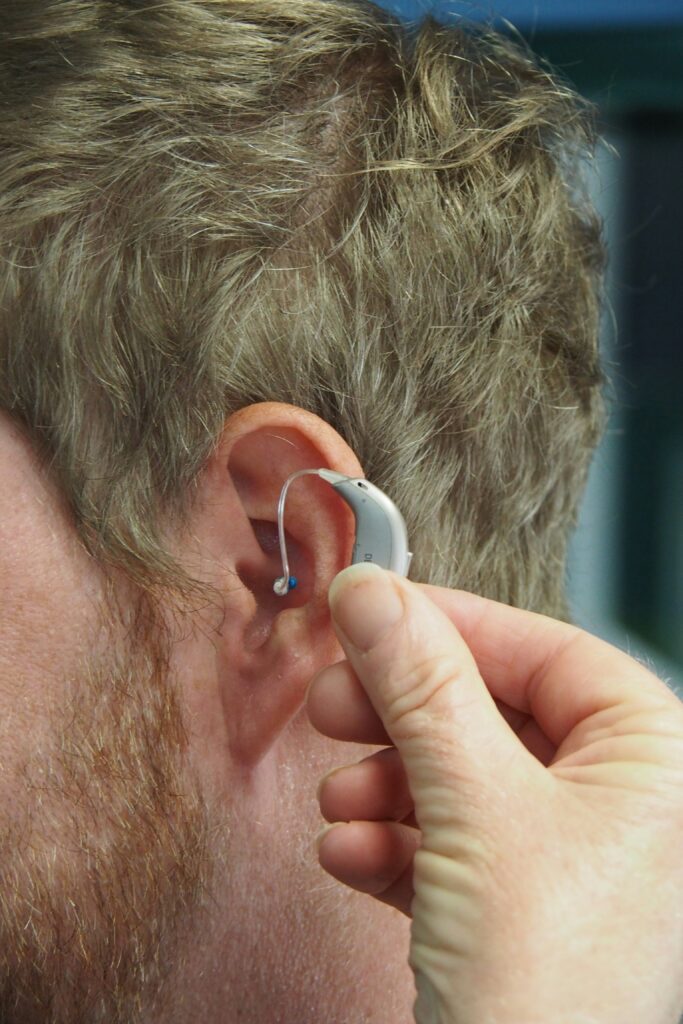
Receiver-in-the-ear (RITE) hearing aids are a more discreet variation of traditional behind-the-ear devices. While a small portion of the hearing aid sits behind the ear, the speaker itself is placed directly inside the ear canal and connected by a thin wire. This design can provide a more natural sound experience and a lighter overall feel.
Pros
RITE hearing aids are among the most popular styles because they balance comfort, cosmetic appeal, and sound quality. Many models include advanced features such as rechargeable batteries, smartphone connectivity, streaming capabilities, and sophisticated background noise management. Their open-fit design may also reduce the “plugged up” feeling some users experience with other hearing aid styles.
Cons
While RITE hearing aids are designed to be low-visibility devices, they are still partially visible behind the ear. Manufacturers have made them increasingly discreet by offering smaller designs and color options that blend naturally with your hair and skin tone.
Behind-the-Ear Hearing Aids
Behind-the-ear (BTE) hearing aids place the main portion of the device comfortably behind the ear, with a thin tube connecting to an earmold or dome inside the ear canal. Because the components are housed outside of the ear, BTE hearing aids are known for their durability, ease of handling, and ability to accommodate a wide range of hearing loss levels.
Pros
BTE hearing aids are appropriate for mild to profound hearing loss and often offer the most powerful amplification options available. Their larger size allows for advanced technology features such as rechargeable batteries, Bluetooth connectivity, directional microphones, and enhanced background noise reduction. They are also easier to handle and maintain for individuals with dexterity or vision concerns.
Cons
Because they sit behind the ear, BTE hearing aids are generally more visible than smaller in-ear styles. Some users may also notice wind noise or a slight plugged sensation depending on the fit and earmold style.