

Hearing Tests in Berkeley, CA
Having trouble following your favorite show?
Missing details at work because you can’t hear in meetings?
Hearing loss can leave you feeling left out.
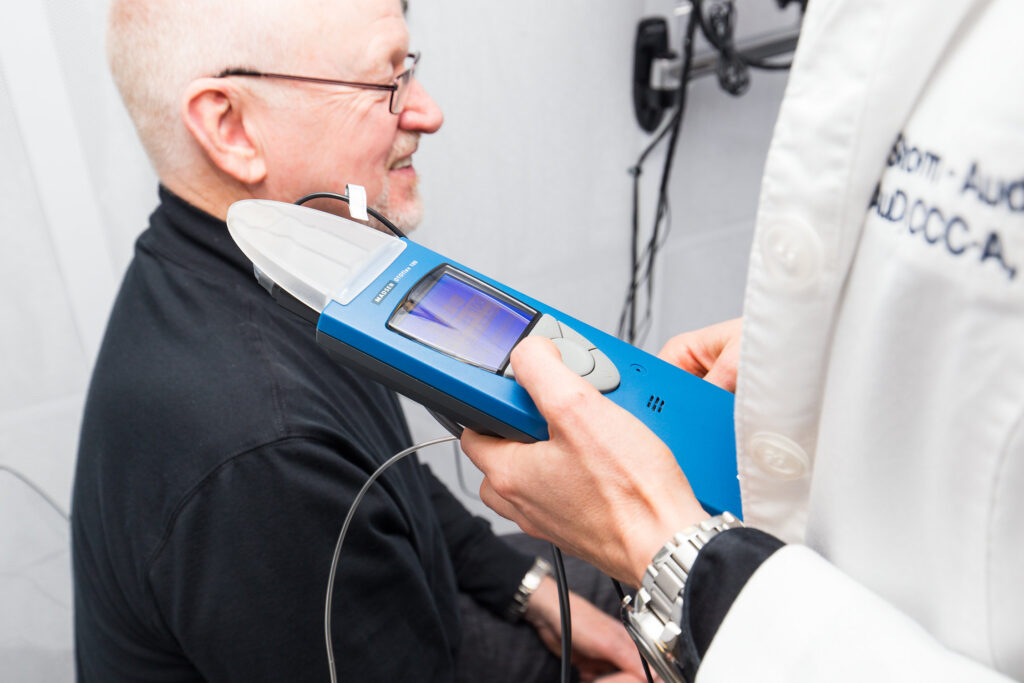
At Blue Sky Hearing, we’re committed to helping you restore your hearing starting with a hearing test.
A hearing test is a key part of maintaining long‑term hearing health. Using several diagnostic measures, it identifies both the degree of hearing loss and the specific frequencies affected. This allows your audiologist to detect even the earliest changes in hearing—often before you’re aware of any symptoms.
Even when no hearing loss is present, a hearing test can provide an invaluable baseline against which future declines may be more easily detected. Once diagnostics are complete, we can determine the best course of action.
Schedule an appointment at our clinic in Berkeley, CA today!
Hearing Tests at Blue Sky Hearing, Berkeley, CA
There are several different types of hearing tests available.
Audiometry
This is the most familiar type of hearing test. While wearing headphones, you’ll listen to tones at different pitches and volumes. Each time you hear a sound in a specific ear, you’ll press a button. Dr. Storm records these responses to determine the softest sounds you can detect across frequencies.
Speech‑in‑Noise Testing
Because real‑world listening rarely happens in quiet, we also assess how well you understand speech in background noise. You’ll hear sentences or words presented with competing noise, and your responses show how your ears and brain work together in more challenging environments. This information is essential for selecting and programming hearing devices that support everyday communication.
Speech testing
Hearing tones is only part of the picture. To understand how well you recognize spoken words, you’ll repeat a standardized list of words and phrases. This helps determine how clearly you hear speech at comfortable listening levels.
There are several other types of tests available, each dedicated to revealing a certain aspect of your hearing health. We’ll examine your overall symptoms and determine which hearing tests best meet your needs.
What Happens During a Hearing Test?
Most hearing tests are conducted in a quiet room. You’ll be given a pair of headphones to listen to sounds, speech, or tones while Dr. Storm observes and notes your responses.
It’s common to undergo multiple diagnostics during your hearing test, as each assesses a different type of hearing loss. Once all diagnostic tests have been completed, we’ll evaluate your results.
What Does a Hearing Test Show?
Hearing tests, such as audiometry, are designed to provide Dr. Storm with enough information to determine the cause, type, and extent of hearing loss. Generally, hearing test results will be shown via a specialized graph called an audiogram. An audiogram is a graph with two axes: sound level (in dB) and tone.
Your hearing range will be diagrammed out on this graph. Usually, there will be several data points–one for each tone tested, plotted at the edge of your hearing range. As a result, an audiogram will show what frequencies you hear well and which frequencies you have a harder time hearing, and the extent and severity of any hearing loss that may be present.
What frequencies you hear well and which frequencies you have a harder time hearing.
The extent and severity of any hearing loss that may be present.
Usually, early hearing loss will affect one frequency more extensively than others. It’s not uncommon, then, to have dips in one area of an audiogram.
Levels of Hearing Loss
The higher your data points appear on an audiogram, the closer you are to a normal hearing range. In general, a normal hearing range is considered to be the ability to hear sounds that are less than 25dB in volume–a sound level roughly equivalent to rustling leaves or whispered words. In general, we use the following categories to define normal hearing and hearing loss:
Normal hearing
The ability to hear sounds 25dB
and below
Mild hearing loss
Sounds between
25dB and 40dB
are audible, but not softer sounds
Moderate hearing loss
Sounds below
41dB and 65dB are difficult for you to hear
Severe hearing loss
Sounds below
66-90dB
are hard to hear
Profound hearing loss
Sounds need to be louder than 90dB for you to be able to hear them.
Hearing loss rarely affects all frequencies equally. You can have completely normal hearing in some parts of the range while experiencing significant loss in others—especially the high frequencies that carry many important speech sounds. Because of this uneven pattern, “normal” hearing at a few frequencies doesn’t mean your overall hearing is functioning well.
Signs You Should Schedule a Hearing Test
Do You Need a Hearing Test? Most people wait an average of seven years after noticing hearing changes before seeking help. If any of this sounds familiar, it may be time to schedule a test.
Hearing loss is gradual — which makes it easy to miss. A hearing test takes about an hour and is completely painless. Even if everything comes back normal, you’ll have a baseline on file to track changes over time.
Hearing Test Costs & Insurance at Blue Sky Hearing
Wondering what a hearing test costs or whether your insurance will cover it? Here’s what you need to know before your visit.